Rainfall
Managed orchards
A farmed crop; a wild rainfall envelope does not apply

Macadamia integrifolia
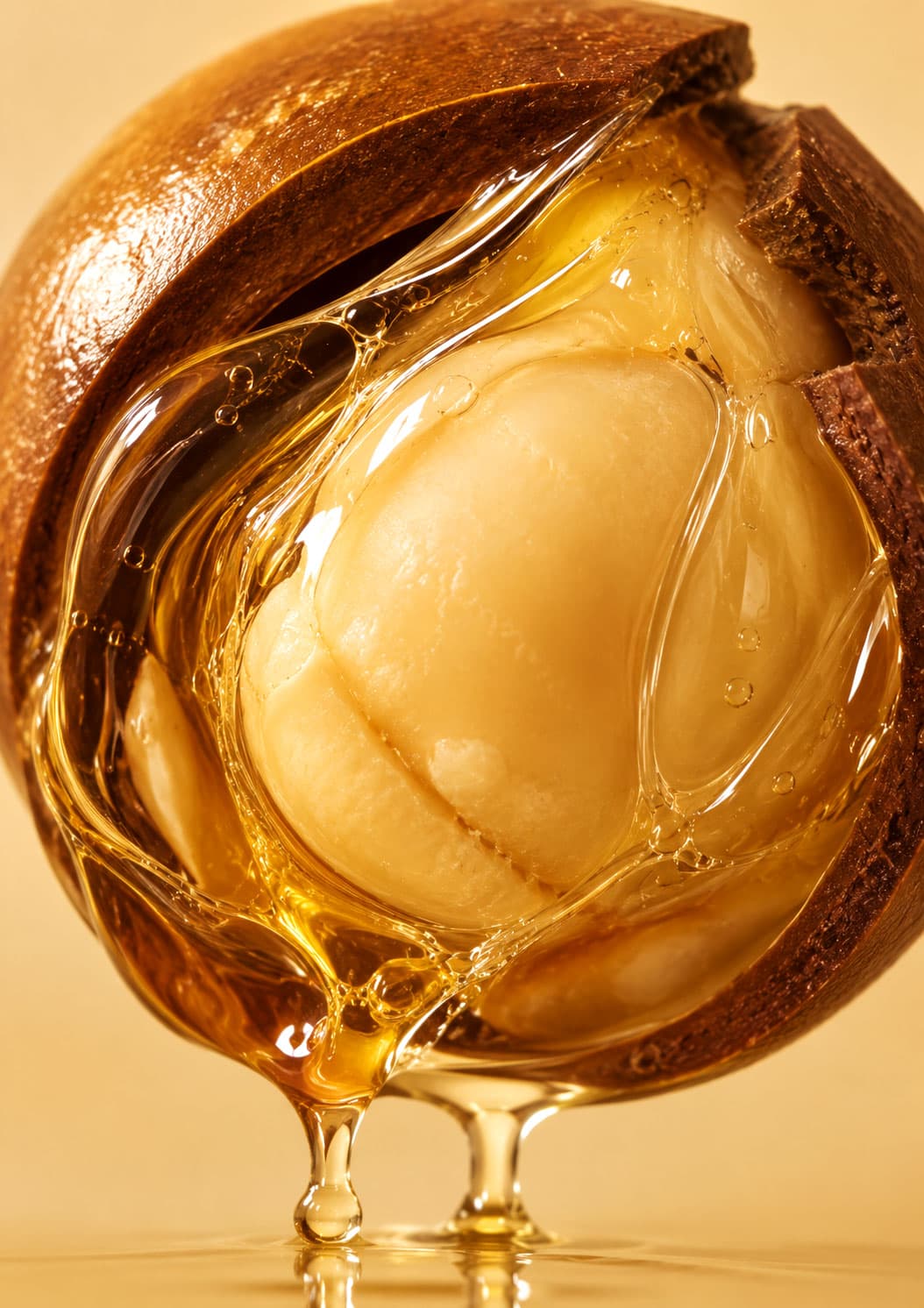
An Australian rainforest tree that became one of southern Africa's great orchard crops, and the light, palmitoleic-rich base oil of both MARU body oils.
Family · Proteaceae
Native to Australia, not to Africa. Included because MARU uses South African macadamia oil; the map shows orchard country, not a native range.
Distribution
Macadamia integrifolia is native to south-east Queensland and north-east New South Wales. In southern Africa it exists as an orchard crop, led by South Africa's Mpumalanga, KwaZulu-Natal and Limpopo provinces, with commercial plantings in Malawi, Mozambique and Zimbabwe. The highlighted countries are growing countries, not a native range.[1][2][3]
Climate
Rainfall
Managed orchards
A farmed crop; a wild rainfall envelope does not apply
Temperature
Hot subtropical
Described as ideal for production; cold snaps and late rains cut the 2025 crop
Altitude
Lowveld to coast
Mpumalanga Lowveld, the KwaZulu-Natal coast and midlands, Limpopo
These describe South African orchard conditions from an industry report, not the species' native rainforest envelope in Australia.[2]
Harvest season
In South Africa flowering begins in July, nuts set by spring, oil accumulates through summer and harvest runs from March into June or July. Nuts are collected from the ground by hand or with sweepers, then de-husked and cured before processing.[2]
Sustainability
A plantation crop raises different questions from a wild harvest: land converted from other crops, input costs, and prices that fell by nearly half in 2023 before recovering. MARU's macadamia oil is South African; the ingredient guide covers sourcing, and this Atlas maps the crop, not the supplier.[2]
Chemical composition
Ranges across 15 cultivars grown in China in one study. South African orchard oil will differ in detail, and the bars mark the middle of each range.[4]
Wildlife interactions
Orchards are managed systems. The report names the stink bug and the macadamia nut borer as key pests, and cold, heat and hail as the weather risks that shaped the 2025 crop. That is the ecology of a farmed tree.[2]
Macadamias are increasingly replacing sugarcane and citrus on South African farms, with KwaZulu-Natal showing the fastest growth and many orchards younger than ten years.[2]
Traditional relationships
There is no long African tradition to record. Macadamia reached southern Africa as a plantation crop within living memory; the industry's own growth curve, from about 6,750 hectares in 2001 to over 81,000 in 2024, is the story here.[2]
Kew records the species as a food and medicinal plant. Its deep human history belongs to the rainforests of eastern Australia, not to this region, and the Atlas does not borrow it.[1]
Very high oleic and palmitoleic content with little linoleic acid explains why macadamia oil feels light and absorbs quickly, and why formulators use it as a base that carries richer oils. It is a fatty-acid explanation, not a clinical claim.[4]
The Atlas found solid compositional chemistry for macadamia oil but cites no human topical study of the oil on skin. Claims that its omega-7 content makes it 'skin-identical' should be read as a chemical resemblance, not a demonstrated outcome.[4]
References
Reviewed 19 September 2026. Botanical ranges and research conclusions may change as records improve.
Cite this page
Maru Skincare™ (2026). Macadamia (Macadamia integrifolia). African Desert Botanical Atlas. Reviewed 19 September 2026.
https://maruskincare.com/za/botanical-atlas/macadamia
Permanent page link ↗From the Atlas to the bottle
This botanical is part of the Maru range. Read how the ingredient behaves on skin, or explore the body oils it lives in.
Connected botanicals